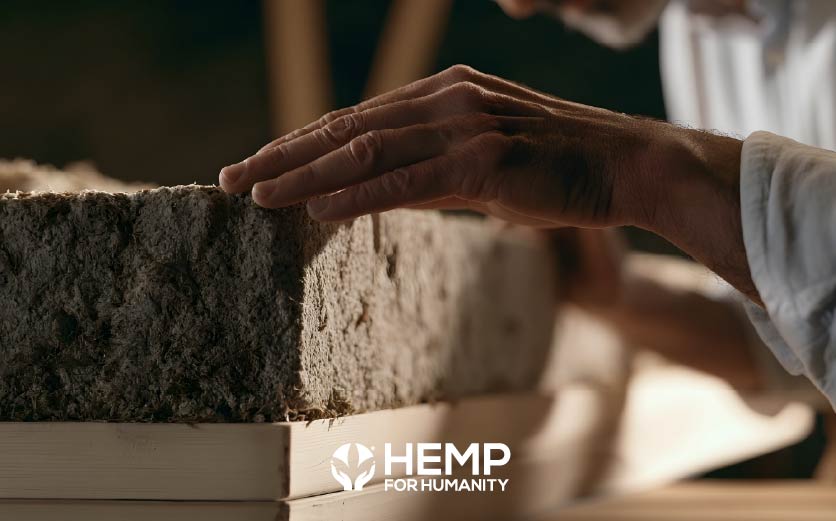
Hemp has attracted considerable attention as a potential building material, particularly among those searching for alternatives to conventional construction products with substantial environmental footprints. One of the most frequently discussed examples is hempcrete, a material made from hemp and a mineral binder. It is often described as carbon-negative, highly insulating and capable of creating healthier indoor environments. These claims are intriguing, but the science behind hempcrete is more nuanced than the headlines suggest. Understanding what the material actually does, and what it cannot do, reveals a surprisingly sophisticated approach to sustainable construction.
Despite its name, hempcrete is not a form of concrete in the conventional sense. Traditional concrete relies on cement, aggregates and water to create a material with substantial compressive strength. Hempcrete, more accurately called hemp-lime, combines the woody inner core of the hemp stalk, known as hemp hurd or shiv, with a lime-based binder and water. The resulting mixture can be cast around a structural frame, formed into blocks or manufactured as prefabricated panels. Once cured, it creates a lightweight, porous material with properties quite different from those of conventional concrete. Crucially, hempcrete is generally not load-bearing. It cannot simply replace reinforced concrete in foundations, columns or other major structural elements. Buildings using hempcrete typically require a separate timber, steel or concrete framework to carry structural loads. This distinction matters because credible environmental comparisons must account for the entire building system, not merely the hemp-based component.
The useful properties of hempcrete begin with the unusual structure of hemp hurd. This woody material contains cellulose, hemicellulose and lignin, arranged within a highly porous cellular architecture. These microscopic spaces help explain why hemp hurd performs well in a lightweight insulating composite. When combined with a mineral binder, the particles become part of a rigid but porous matrix that can slow heat transfer while allowing water vapour to move through the material. Hemp hurd is also a relatively low-density agricultural resource. Unlike materials that require energy-intensive mineral processing, it originates from plant biomass produced through photosynthesis. However, processing still matters. Hemp stalks must be harvested, dried, separated and graded to obtain hurd suitable for construction. Particle size, moisture content and consistency can all influence the performance of the finished product.
One of hempcrete’s most interesting characteristics is that it combines thermal insulation with moisture-buffering capacity. Its porous structure reduces heat transfer, although hempcrete generally does not match the insulation performance of specialised insulation materials at equal thickness. Consequently, hempcrete walls may need to be relatively thick to achieve demanding thermal performance standards. The material also exhibits hygroscopic behaviour: it can absorb and release water vapour as indoor humidity changes. This helps moderate fluctuations in relative humidity and may contribute to indoor comfort. Its moisture behaviour is particularly relevant because buildings must manage both temperature and water. Poor moisture control can contribute to condensation, mould growth and material deterioration. Nevertheless, hempcrete is not waterproof. Appropriate foundations, weather protection, compatible finishes and careful detailing remain essential.
Perhaps the most widely promoted environmental advantage of hempcrete is its potential to store atmospheric carbon. During growth, hemp absorbs carbon dioxide through photosynthesis and incorporates carbon into its biomass. Some of that carbon remains stored in the hemp hurd when it becomes part of a building. Lime-based binders may also absorb carbon dioxide through carbonation as they cure and age. However, producing these binders requires energy and releases carbon dioxide, particularly during limestone calcination. Whether a hempcrete product achieves a negative carbon footprint therefore depends on several variables: agricultural practices, processing, binder composition, transportation, construction methods and the boundaries of the life-cycle assessment. Carbon storage within a material is not automatically equivalent to permanent carbon removal. The duration of storage and what happens when the building is demolished or renovated are equally important.
A building material should not be evaluated solely by its environmental impact on the day it is manufactured. Buildings may remain in service for many decades, sometimes centuries. During that period, insulation performance, maintenance requirements, moisture management and durability influence their overall environmental footprint. A hempcrete wall that performs reliably for a long period may offer advantages extending beyond its initial embodied carbon. Conversely, premature deterioration or inappropriate construction detailing could undermine those benefits. End-of-life treatment also matters. Reuse, recycling, disposal and decomposition can produce different carbon outcomes.
Hempcrete is neither a miracle replacement for concrete nor simply an environmentally fashionable building product. It is a specialised construction material with a distinctive combination of thermal, moisture-regulating and potential carbon-storage properties. Its greatest value may lie in how these characteristics work together within a carefully designed building. The important question is not whether hempcrete can replace conventional construction materials everywhere. It is where hemp-lime systems can deliver measurable advantages while meeting structural, technical and durability requirements. That is a more demanding question than the promotional headlines suggest, but also a considerably more interesting one.
Dr. Peter Verdegem, Ph.D., MBA
Leave a Reply