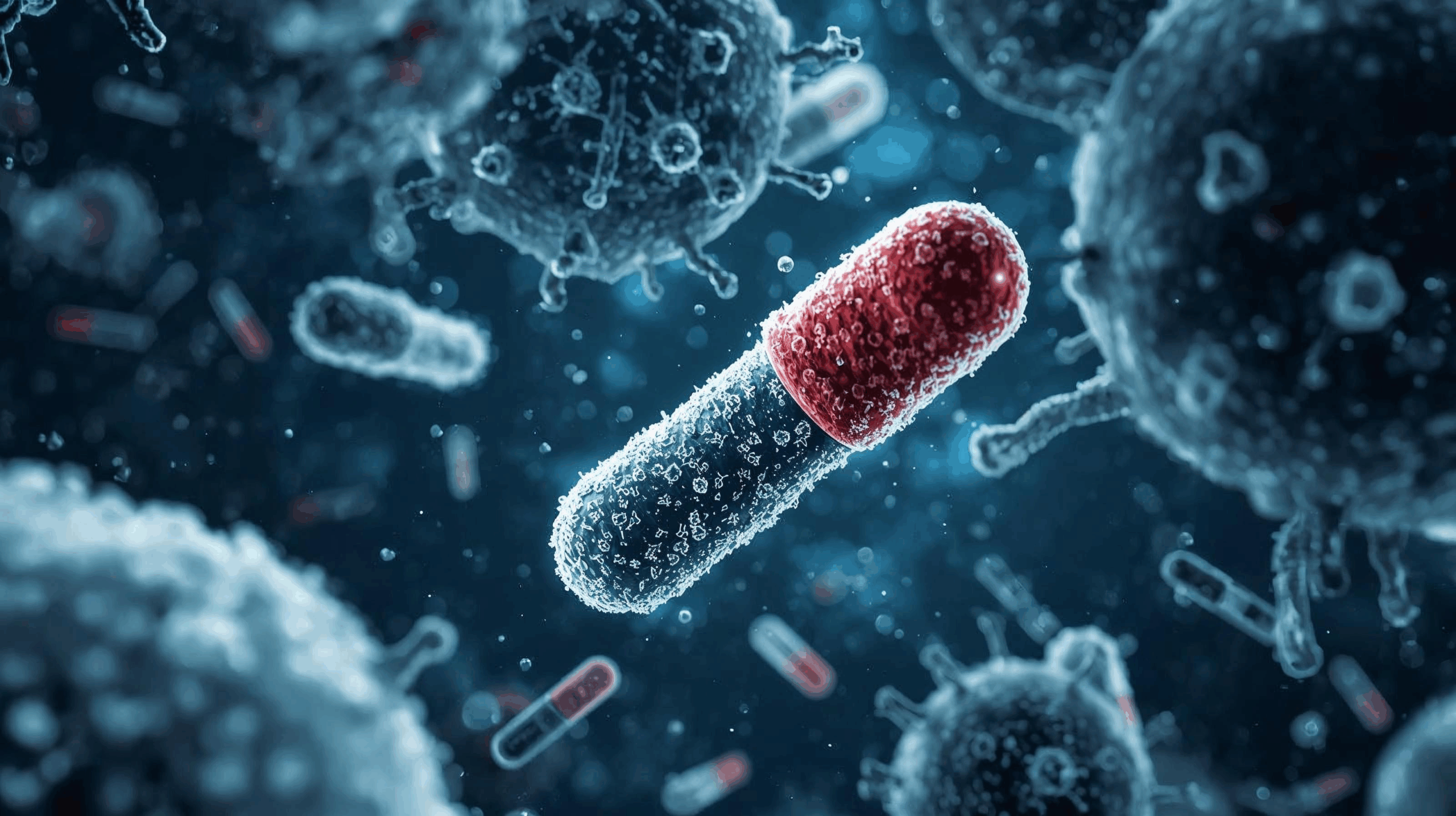
A crisis hiding in plain sight
Antibiotic resistance is one of the most serious public health challenges of our time. The World Health Organization has listed it among the ten greatest threats to global health, and the numbers behind that warning are sobering: drug-resistant bacteria already cause more than a million deaths per year worldwide, and that figure is projected to rise dramatically in the decades ahead if no new solutions emerge.
The problem, at its core, is that bacteria evolve. Every time we use an antibiotic, the few bacterial cells that happen to carry a resistance mutation survive and reproduce. Over decades of overuse — in medicine, in agriculture, in food production — we have accelerated that process to the point where some strains of bacteria are now resistant to virtually every antibiotic in our arsenal. Methicillin-resistant Staphylococcus aureus (MRSA) is the most well-known example, but it is far from the only one.
Scientists have been searching urgently for new classes of antibacterial compounds — molecules that work differently from existing drugs and that bacteria haven’t yet learned to resist. Increasingly, that search is leading researchers to an unexpected place: the hemp plant.
CBG: more than just a mood cannabinoid
Most people who have heard of CBG know it as the “mother cannabinoid” — the precursor molecule from which the hemp plant synthesises CBD, THC, and most other cannabinoids. Recently, a landmark human clinical trial confirmed what users had been reporting for years: CBG reduces anxiety and stress without intoxication, and even enhances verbal memory. That story, which we covered in our previous blog post, marked a turning point for CBG as a wellness cannabinoid.
But CBG has another side to its profile that has been quietly building in the scientific literature — and it has nothing to do with mood. It has to do with bacteria.
Four new peer-reviewed studies, all now listed on our research page at hempforhumanity.eu/research, paint a remarkably consistent picture: CBG is a potent antibacterial compound with particular effectiveness against the drug-resistant bacteria that are causing the most alarm in hospitals around the world.
Study 1: Uncovering the hidden antibiotic potential of cannabis
The foundational paper in this area came from a team at McMaster University in Canada, published in ACS Infectious Diseases. The researchers screened a range of cannabinoids against a panel of bacteria — and CBG stood out.
Against MRSA, CBG demonstrated potent antibacterial activity by targeting the cytoplasmic membrane of the bacteria — essentially breaching the cell wall in a way the bacteria cannot repair. In live animal models infected with MRSA, CBG reduced bacterial load significantly. The researchers also found that CBG was effective even against MRSA biofilms — the protective films that bacteria create on surfaces like medical implants and catheters, which are notoriously difficult to treat because antibiotics simply cannot penetrate them.
This was the study that put CBG on the antibacterial map. The researchers described cannabinoids as a promising new class of antibiotics — strong language from a peer-reviewed paper.
Study 2: CBG combined with silver — a synergistic effect
A 2024 study took the antibacterial research a step further by asking whether CBG could be combined with other antimicrobial agents to produce even stronger effects.
The answer was yes. Testing six cannabinoids — including CBG, CBD, CBC, and their acidic precursor forms CBGA, CBDA, and CBCA — against MRSA, the researchers found that all six had strong antibacterial activity. CBG achieved a minimum inhibitory concentration of just 2 mg/L against MRSA, placing it firmly in the range of clinically useful antibiotics.
Beyond raw potency, combining CBG, CBC, and CBGA with silver nitrate produced a synergistic effect — the combination was more powerful than either compound alone. This points towards potential combination therapies, where cannabinoids could work alongside existing compounds to overcome resistance mechanisms that have defeated conventional antibiotics.
Study 3: Engineering better antibiotics from CBG
If CBG works as an antibiotic, the next logical question is: can we make it even more effective? That is precisely what a study published in ACS Omega set out to explore.
Researchers synthesised 26 different derivatives of CBG and CBGA, systematically varying the molecular structure to understand which parts of the molecule are responsible for the antibacterial effect. The results were clear: variants with terpene chain lengths of between 6 and 13 carbons showed the most potent activity against both MRSA and vancomycin-resistant Enterococcus faecalis (VRE) — another superbug of major concern.
Equally significant: none of the active derivatives showed detectable toxicity to mammalian cells. That is an essential requirement for any compound that might one day be developed into a medicine: it needs to kill bacteria without harming the patient.
This kind of structure-activity research is the foundational science that pharmaceutical development is built on. Researchers do not invest in this kind of molecular engineering unless they believe a compound has genuine therapeutic potential.
Study 4: A systematic review confirms the pattern
The fourth study is perhaps the most significant for establishing the overall credibility of this research area: a 2024 systematic review that rigorously evaluated the evidence for cannabinoids as antibacterial agents against Streptococcusand Staphylococcus species.
Systematic reviews sit at the top of the evidence hierarchy in medicine. They are designed to cut through individual studies and ask whether the evidence as a whole points in a consistent direction. In this case, it does. CBG, CBD, and THC all showed significant antibacterial activity against Staphylococcus aureus, MRSA, and Streptococcus pyogenes. The review authors concluded that cannabinoids represent promising candidates as alternatives or adjuncts to conventional antibiotics, and called for clinical trials to move the research from the laboratory into clinical settings.
A systematic review closing with a call for clinical trials carries real weight — it signals that the preclinical evidence is consistent and compelling enough that researchers are ready to move these compounds into human studies.
What the research is actually pointing toward
There is a temptation, when reading about plant compounds and antibiotic resistance, to treat the findings as curiosities — interesting but distant from anything that might affect your medicine cabinet.
We think that framing is wrong, for two reasons.
First, the antibacterial research on CBG is genuinely rigorous. These are not fringe studies or alternative medicine papers. ACS Infectious Diseases, ACS Omega, and the journals that published the systematic review are peer-reviewed scientific publications with high standards. The McMaster University team, in particular, is a serious academic research group working in mainstream pharmacology.
Second, the antibiotic resistance crisis is not a distant future problem — it is already here. Every year, procedures that were once routine — hip replacements, cancer chemotherapy, organ transplants — become riskier as the drugs used to prevent post-operative infections become less reliable. CBG is not going to single-handedly solve that crisis. But it may become one of the tools in the solution, and the science is moving faster than most people realise.
CBG: a cannabinoid of many talents
What is striking about the emerging picture of CBG is its breadth. Within the space of a few years, peer-reviewed research has now established compelling evidence for CBG’s potential across anxiety and stress reduction, neuroprotection, antibacterial activity, anti-inflammatory effects, and metabolic health. Few plant-derived molecules have attracted this level of serious scientific attention across so many different therapeutic areas simultaneously.
For the people who have been using CBG-rich hemp extracts for their mood and focus benefits, the antibacterial research is a reminder that the compound they are taking may be doing more than they realise. The hemp plant has been co-evolving with bacteria and fungi for millions of years, and CBG is one of the molecules it uses to protect itself. It should not surprise us that those defences might be useful to us too.
All four studies referenced in this article are now listed on our research page. We will continue adding new findings as the science develops.
Read the studies on our research page: hempforhumanity.eu/research
Direct links to the four studies:
- Uncovering the Hidden Antibiotic Potential of Cannabis: https://www.researchgate.net/publication/339033053_Uncovering_the_Hidden_Antibiotic_Potential_of_Cannabis
- Combinations of Cannabinoids with Silver for Synergistic Effects against MRSA: https://www.ncbi.nlm.nih.gov/pmc/articles/PMC11200472/
- Structure-Activity Relationships of CBG and CBGA Derivatives as Antibacterial Agents: https://pubs.acs.org/doi/10.1021/acsomega.6c00126
- Cannabinoids as Antibacterial Agents — Systematic Review: https://pmc.ncbi.nlm.nih.gov/articles/PMC11591022/
This article is for informational purposes only and does not constitute medical advice. CBG is not a treatment for any diagnosed condition. If you are considering adding CBG or any other cannabinoid to your routine — especially if you are pregnant, nursing, or taking prescription medication — please speak with a qualified healthcare professional first.
Follow Hemp for Humanity on Telegram: https://t.me/hempforhumanityofficial
Recent Comments