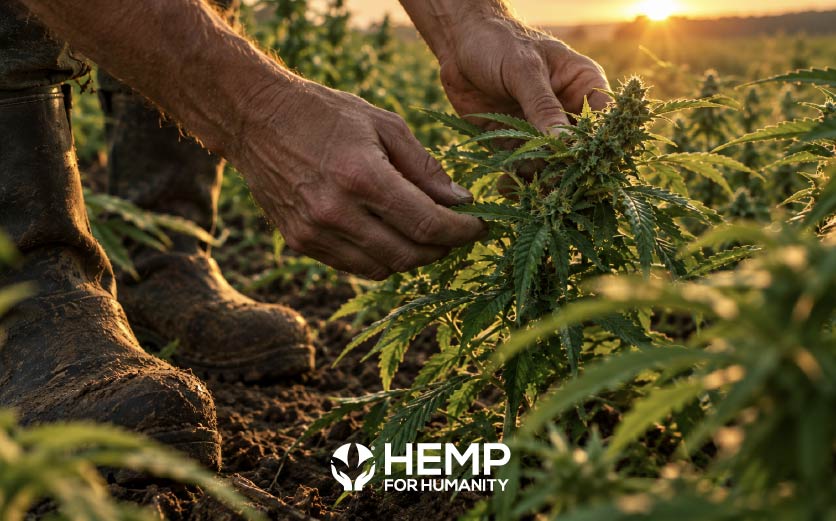
Hemp is often presented as an almost ideal crop for the future: fast-growing, versatile, relatively low in chemical inputs and capable of supplying raw materials for everything from food and textiles to construction materials and wellness products. But what happens when we stop looking at hemp through the eyes of marketers and policymakers and ask the farmers who actually have to grow it?
A 2025 study published in the Journal of Environmental Management offers an unusually practical perspective. Researchers examined industrial hemp cultivation from the viewpoint of German farmers, considering its economic, environmental and social dimensions. The picture that emerged was encouraging, but considerably more complicated than the sustainability story we often hear. Farmers clearly recognize opportunities in hemp, but they also encounter very practical obstacles that determine whether growing it actually makes sense as a business.
Farmers See Real Agronomic Advantages
One of hemp’s attractions is its relatively low requirement for crop-protection chemicals. Farmers in the study identified favorable operating costs, particularly because pesticide requirements can be minimal. Hemp can also fit productively into crop rotations, suppress weeds, contribute to soil protection and potentially provide benefits for subsequent crops. This matters because farmers do not evaluate sustainability only in abstract environmental terms. A crop has to work within an actual farming system, alongside other crops, available machinery, labor and the economic realities of running a farm.
Hemp can potentially provide several income streams – from seeds and fiber to other processed products – and give farmers another way to diversify their operations. In some cases, existing agricultural machinery can be adapted for hemp cultivation. On paper, therefore, there are plenty of reasons for a European farmer to be interested. But successfully growing hemp is only the beginning of the story.
Growing Hemp Is Only Half the Problem
A farmer can produce an excellent field of hemp and still have an unsuccessful hemp business. The German farmers pointed to market uncertainty, limited processing infrastructure and dependence on relatively few buyers as significant obstacles. Without reliable purchase agreements and accessible processors, hemp becomes a considerably riskier proposition than established commodity crops supported by mature systems for storage, transportation, processing and trading.
This creates a classic chicken-and-egg problem. Processing companies need sufficient hemp acreage to justify investment in specialized facilities and equipment. Farmers, meanwhile, may be reluctant to dedicate larger areas to hemp until they know that reliable processors and buyers exist. Specialized harvesting and processing equipment can also be difficult to justify economically when cultivation volumes remain relatively small. Building a hemp industry therefore requires more than persuading individual farmers to plant hemp. The entire chain needs to develop together.
Sustainability Does Not Remove Practical Challenges
The environmental case for hemp remains interesting. Farmers reported advantages such as weed suppression, relatively low pesticide requirements and soil-protection benefits, while hemp is also attracting attention for its potential contribution to carbon sequestration. Yet none of this makes hemp an agronomic miracle crop requiring little management. Farmers identified challenges involving water requirements during establishment, sensitivity to soil compaction, harvesting and the management of crop residues. Climate, soil and local farming conditions also matter, meaning that experience from northern Germany cannot automatically be transferred to every agricultural region in Europe.
There is also a social dimension that is surprisingly persistent: industrial hemp is still confused with drug cannabis. Farmers reported that acceptance tends to improve once people understand the distinction, suggesting that education remains important not only for consumers but within agricultural communities as well. Regulatory complexity and administrative burdens can create another layer of difficulty, especially for farmers considering hemp for the first time.
A Hemp Economy Has to Work for the Farmer
Perhaps the most important lesson from this research has little to do with cannabinoids. If Europe wants to develop a substantial hemp economy, enthusiasm for hemp-based finished products is not enough. There must be an economically sustainable agricultural system underneath them. That means dependable buyers, regional processing capacity, sensible regulation, agronomic knowledge, suitable equipment and supply chains capable of turning a harvested crop into something valuable.
The farmer cannot simply be the person at the beginning of a sustainability story told by somebody else. If companies want to promote hemp as a sustainable European resource, sustainability must extend all the way back to the field and include the economic sustainability of the people growing it.
For hemp to become a meaningful European agricultural crop, farmers need more than environmental arguments or attractive visions of a hemp-based future. They need a compelling economic and practical reason to plant it again the following year. And ultimately, that may be one of the best measures of whether the hemp economy is truly sustainable.
Leave a Reply