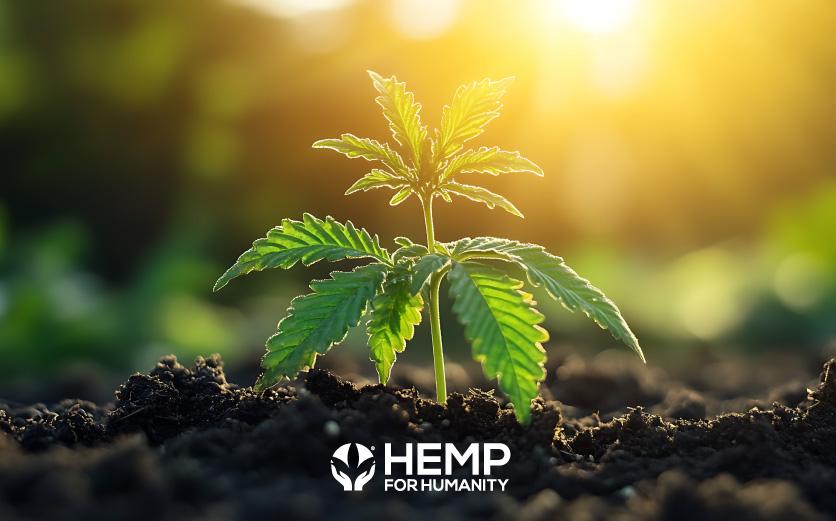
Hemp is often discussed in terms of what can be made from it: fibres, food ingredients, construction materials, and cannabinoid products. But an increasingly interesting question begins before any of these products exist: what happens to the soil when hemp is grown?
A 2025 field study from researchers at the University of Florida provides new evidence that industrial hemp may have a useful role in agricultural soil management. Rather than looking at hemp simply as a commercial crop, the researchers examined changes in soil quality and nutrients during hemp cultivation. Their results suggest some potentially valuable effects—but also show why sustainability claims about hemp need to remain measured.
Looking below the surface
The study was conducted over two years at three research locations in Florida, representing different soils and subtropical growing environments. Researchers cultivated three hemp varieties and monitored indicators including soil organic matter, nitrogen, phosphorus and potassium. They also examined different nitrogen fertilisation rates.
One particularly interesting result involved nitrate.
Hemp cultivation consistently reduced nitrate-N remaining in the soil, regardless of the hemp variety grown. This matters because nitrate that is not taken up by crops can move through the soil and potentially be lost from the agricultural system through leaching. Improving the capture and use of nutrients is therefore an important part of both agricultural efficiency and environmental management.
Researchers also observed improvements in some soil-quality measurements, including increases in organic matter at certain locations and times. However, the results were not identical between sites or years. Nitrogen and other nutrients sometimes increased and sometimes decreased depending on location, year and management conditions.
That variability may be one of the study’s most important lessons.
Hemp as part of a rotation
The agricultural potential of hemp becomes especially interesting when we stop thinking about it as a crop that must be grown continuously.
Crop rotation means deliberately changing the crops grown on a field over successive seasons. Different plants have different root systems, nutrient requirements and interactions with soil biology. A well-designed rotation can therefore help farmers manage nutrients, soil structure, pests and diseases while reducing some of the problems associated with repeated monoculture.
Hemp’s root system and rapid biomass production make it an interesting candidate for such systems. Previous rotation research has also shown that continuous hemp cultivation is not necessarily desirable: rotational systems can perform better than hemp monoculture, reinforcing the idea that hemp’s agricultural value may depend on how it is integrated with other crops.
This fits a broader principle of sustainable agriculture. A crop does not need to be environmentally perfect to be useful. Its value may lie in what it contributes to the farming system around it.
Promising does not mean universal
The Florida findings are encouraging, but they should not be turned into a simple claim that “hemp improves soil.”
Soil is extraordinarily complex. Climate, rainfall, temperature, soil texture, previous land use, hemp variety, fertilisation, irrigation and cultivation methods can all influence the outcome. Research in Kentucky, for example, found relatively limited changes in several soil-health indicators after hemp was incorporated into corn-soybean rotations, with substantial differences between research sites.
That is exactly why more field research matters.
The next step is to compare hemp-based rotations across different climates, soil types and farming systems and to determine which benefits are reproducible over multiple growing seasons.
The emerging picture is therefore more interesting than a sustainability slogan. Hemp may offer farmers another tool for managing nutrients, diversifying crop rotations and supporting resilient agricultural systems. But its environmental value will ultimately depend not simply on whether hemp is grown, but where, why and how it is grown.
Sources
2025 field study, Agricultural & Environmental Letters (Wiley): https://acsess.onlinelibrary.wiley.com/doi/10.1002/agg2.70231
Industrial hemp crop rotation research, Agronomy (MDPI): https://www.mdpi.com/2073-4395/12/10/2293
Kentucky hemp rotation research, University of Kentucky: https://uknowledge.uky.edu/pss_etds/195/
:::
Written by Dr. Peter Verdegem, Phytonutrient Reseacher
This article is for educational purposes and does not constitute medical advice.
Follow Hemp for Humanity on Telegram: https://t.me/hempforhumanityofficial
Recent Comments