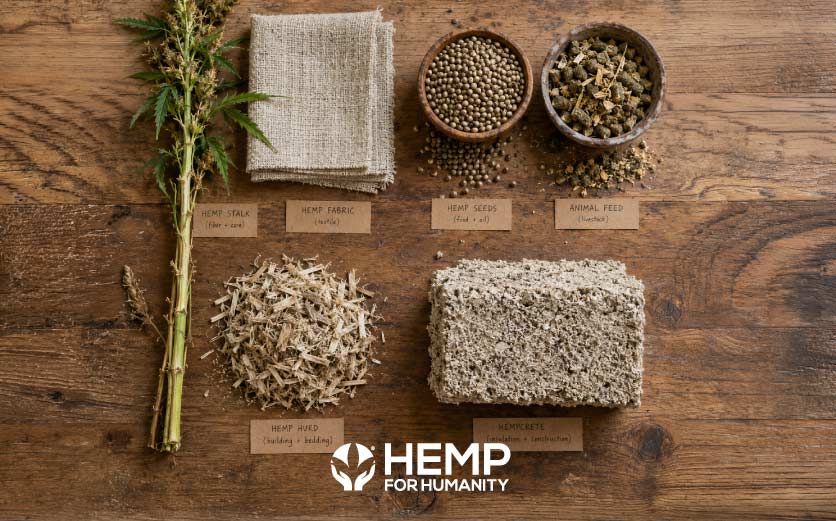
When we think about the value of hemp, attention often goes to the part of the plant that becomes the final product: seeds pressed for oil, fibres turned into textiles, or flowers processed for cannabinoids. But an increasingly important question is being asked by researchers and industry: what happens to everything that remains? Recent research is exploring how hemp by-products and processing residues might be transformed into animal feed ingredients, construction and packaging materials, carbon-based products and other industrial resources. Instead of treating stalks, hurd, seed cake, leaves or spent biomass simply as waste, they can potentially become raw materials for another process. This is the idea behind the whole hemp plant economy.
Hemp is particularly interesting for a circular bioeconomy because different parts of the plant have very different properties. The long bast fibres in the stalk can be used in textiles and composite materials, while the woody inner portion, known as hurd or shiv, can be used in construction materials, animal bedding and biocomposites. Seeds can provide food ingredients and valuable oil, while the material remaining after pressing the seeds—often called hempseed cake or meal—still contains protein, fibre and residual oil. Then there are leaves, flowers and biomass remaining after cannabinoid extraction. Traditionally, some of these fractions have had relatively little economic value. Researchers are now asking whether we can do better.
The principle is sometimes described as cascading use. Rather than choosing a single purpose for a crop, processors try to obtain the highest-value components first and then continue finding productive applications for what remains. Imagine hempseed as a simple example. Oil can be extracted first. The remaining protein-rich material may have potential as a food or feed ingredient. Other residues could subsequently be processed into biomaterials, fermented products, energy or carbon-rich materials. One harvest can therefore potentially generate several value streams.
Animal nutrition is one area attracting considerable research interest. Hempseed cake and meal are especially interesting because they retain protein and fatty acids after oil extraction. Reviews have examined hemp-derived materials in poultry, cattle, sheep, pigs and aquaculture, and research suggests that some hempseed-derived co-products could potentially serve as alternative or complementary feed ingredients. Other parts of the plant are more complicated. Studies have found substantial differences between hemp leaves, stalks and other plant fractions in nutrient digestibility and cannabinoid concentrations. Leaves may provide useful nutrients, for example, but cannabinoids can also be more concentrated in leaves and flowers. That distinction matters. Regulatory approval, cannabinoid residues and possible transfer into animal-derived foods such as meat or milk must be carefully evaluated before some hemp materials can be widely adopted as livestock feed. Hemp biomass should therefore not automatically be considered suitable animal feed simply because it comes from a plant.
Other residues may have a completely different destination. Hemp stalks and other lignocellulosic biomass contain carbon that can potentially be converted through processes such as pyrolysis into biochar and other carbon-rich materials. Biochar is being investigated for applications ranging from soil improvement and carbon management to adsorption and environmental technologies. Researchers are also examining the balance between recovering energy from hemp biomass and retaining carbon in useful solid materials. This creates an interesting possibility: biomass remaining after higher-value components have been removed may still have useful properties at the very end of the processing chain.
Hemp’s structural components provide yet another route. Decortication separates the strong outer bast fibre from the woody hurd. These fractions can enter very different industries, including textiles, packaging, construction and biocomposites. In this context, an agricultural residue starts to look less like waste and more like an industrial raw material. A hemp stalk contains cellulose, lignin, fibre and carbon arranged by biology. If these components can be efficiently separated and processed, each may have value in a different part of the economy.
Perhaps the most interesting aspect of the whole-plant approach is economic. If farmers and processors can sell several fractions from the same crop rather than relying on one primary product, additional revenue streams may become possible. At the same time, finding uses for processing residues could reduce disposal requirements and improve overall resource efficiency. This does not automatically make every hemp application sustainable. Processing requires energy, transportation matters, markets must exist for the resulting products, and life-cycle and economic assessments remain important. The best solution will depend on where hemp is grown, how it is processed and what infrastructure exists nearby.
The future hemp economy may therefore not be built around one miracle product. It may be built around something much more practical: learning how to use more of what the plant already gives us. Oil, protein, fibre, hurd, extracts, biomaterials, feed ingredients and carbon products could increasingly become interconnected parts of the same value chain. In a circular bioeconomy, the question is no longer simply, “What can we make from hemp?” It is becoming: “How much value can we create from the whole plant before anything is considered waste?”
Leave a Reply