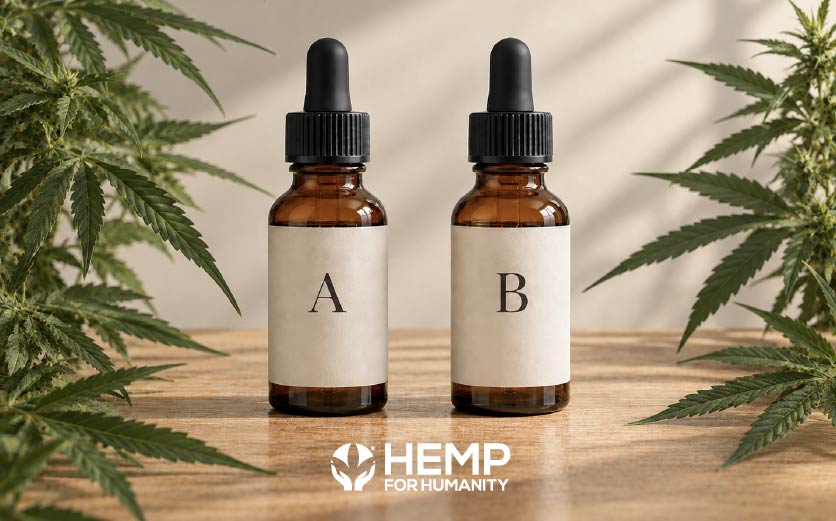
Walk into a store, browse a website or compare two hemp products online and you will often see one number taking centre stage: 1,000 mg CBD. It looks wonderfully simple. Product A contains 1,000 mg. Product B contains 1,000 mg. Surely the products are essentially equivalent, and the sensible comparison is therefore price? Not quite.
The amount of CBD in a bottle is certainly useful information, but it tells us surprisingly little about the finished product. Two bottles can both contain 1,000 mg of CBD and still differ substantially in their composition, concentration, formulation, testing and manufacturing quality. Understanding those differences is a much better way to compare hemp products than simply reaching for a calculator and dividing the price by the number of milligrams.
One of the first questions is: where did those 1,000 milligrams come from? CBD can be incorporated into a product in different forms. A formulation may use highly purified CBD isolate, a broad-spectrum hemp extract containing CBD alongside other naturally occurring hemp constituents, or a more complex hemp extract containing a wider cannabinoid and phytochemical profile. These are not automatically interchangeable formulations. An isolate-based product is predominantly about one molecule: CBD. A more complex hemp extract may contain additional cannabinoids and other hemp-derived compounds. Neither description, by itself, tells us whether a product is “better,” but it does tell us that comparing them solely because both say 1,000 mg CBD overlooks an important part of what is actually inside the bottle.
CBD is also only one cannabinoid associated with Cannabis sativa L. Depending on the raw material and extraction and manufacturing processes, a hemp extract may contain measurable quantities of other cannabinoids, such as CBG, CBC, CBDa or CBN. This means the better question is not simply, “How much CBD does it contain?” It is also, “What else does the cannabinoid analysis show?” This is where a Certificate of Analysis, or COA, becomes valuable. A credible laboratory report allows us to look beyond the marketing language and examine the actual cannabinoid profile of the tested product or batch.
There is another commonly overlooked detail: 1,000 mg is not a concentration. Imagine one product contains 1,000 mg CBD in a 10 ml bottle and another contains 1,000 mg in a 30 ml bottle. Both can truthfully display “1,000 mg CBD,” yet their concentrations are very different. The first contains approximately 100 mg CBD per ml, while the second contains approximately 33 mg per ml. That difference affects how much product corresponds to a particular quantity of CBD. Bottle size, concentration and defined serving size therefore matter. The large number on the front is only part of the story.
The carrier oil is part of that story as well. CBD is lipophilic: it has greater affinity for fats than for water, so oil-based products require an appropriate carrier. Common carrier oils include MCT oil and various plant-derived oils. The choice of carrier can influence characteristics such as taste, texture, stability and the overall formulation. Again, the point is not that one carrier is universally superior to another. It is that the carrier is part of the finished product. When comparing two products, we should be comparing formulations, not isolated numbers.
Perhaps the biggest difference between two apparently similar CBD products may be something that is not obvious from the front label at all: quality control. Does laboratory testing confirm the cannabinoid content? Is testing performed on the finished product or relevant production batches? Are appropriate contaminants assessed? Can the consumer access a relevant COA? Depending on the product and applicable requirements, quality testing may examine factors such as cannabinoid potency, THC, heavy metals, pesticides, microbiological contamination or residual solvents. A label tells you what the manufacturer declares is in the bottle. Robust analytical testing provides evidence supporting that declaration. For a scientifically responsible Brand Ambassador, that distinction matters.
A cannabinoid product is also the result of an entire production chain: cultivation, harvesting, extraction, formulation, manufacturing, packaging and storage. Raw-material specifications, controlled processes, traceability, consistency between batches and appropriate manufacturing standards all contribute to the quality of the finished product. Two products with identical headline CBD numbers may therefore have very different stories behind them and those differences are not captured by “price per milligram.”
Price is a perfectly reasonable consideration. CBD content is a perfectly reasonable consideration. Neither should be ignored. But dividing the retail price by the stated milligrams of CBD and declaring whichever product produces the lowest number the “best value” is an oversimplification. A more informed comparison asks: What type of extract is used? What is the cannabinoid profile? What is the concentration? What is the carrier? What does the laboratory testing demonstrate? How is the product manufactured and controlled?
This approach also gives Brand Ambassadors a more responsible way to talk about hemp products. There is no need to make exaggerated health claims or declare one product medically superior to another. Instead, we can help people understand what they are actually comparing. Because 1,000 mg CBD is a quantity, not a complete description of a product. And when it comes to hemp, the details behind that number can tell us far more than the number itself.
Leave a Reply