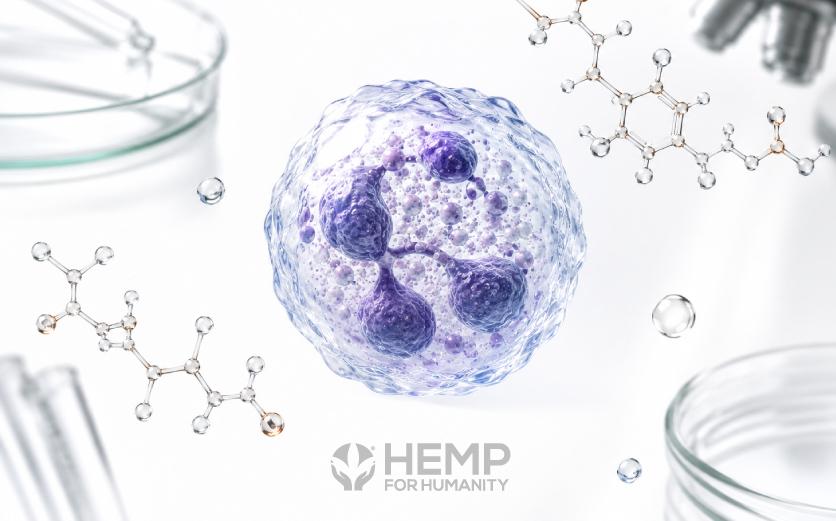
Cannabigerol, better known as CBG, is receiving increasing attention from researchers interested in the relationship between cannabinoids and the immune system. While CBD and THC have historically dominated cannabinoid research, scientists are now investigating some of the less abundant cannabinoids and asking a more detailed question: how might individual cannabinoids influence specific immune cells and signalling pathways?
A recently published study provides an interesting example. Researchers examined how purified CBG interacts with neutrophils, a type of white blood cell that forms an important part of our body’s rapid immune response.
Neutrophils – essential, but potentially destructive
Neutrophils are among the immune system’s first responders. When tissue is injured or an infection develops, chemical signals attract neutrophils to the affected area. They migrate through the bloodstream, enter the tissue and help the body respond to the threat.
This response is essential. However, excessive or prolonged neutrophil activity can also contribute to inflammation and tissue damage. Rheumatoid arthritis is one condition in which neutrophils are involved in the inflammatory environment within affected joints.
Researchers therefore wanted to understand whether CBG could influence some of these neutrophil activities.
The study examined isolated human blood neutrophils in laboratory experiments. Researchers found that CBG reduced the secretion of two important pro-inflammatory signalling molecules, TNF-α and IL-6, in a concentration-dependent manner. It also affected intracellular signalling pathways involving p38-MAPK, ERK1/2 and Akt.
Perhaps particularly interesting was what happened to neutrophil migration.
Neutrophils normally respond to chemical signals that essentially tell them where they are needed. In the experiments, CBG reduced neutrophil migration toward the signalling molecule IL-8 by 67 percent. Part of CBG’s effect on IL-6 also appeared to involve the cannabinoid CB2 receptor, a receptor that has long attracted interest because of its relationship with immune function.
From cells to an animal model
The researchers then moved to another level of experimentation, using a mouse model of rheumatoid arthritis.
CBG treatment was associated with lower arthritis clinical scores and reduced recruitment of immune cells into inflamed joints. Total leukocyte recruitment decreased, with researchers observing changes particularly among neutrophils and monocytes. Several inflammatory signalling molecules were also reduced in the blood or joint tissue.
These findings are certainly interesting. But this is also where responsible interpretation of cannabinoid science becomes especially important.
Mechanism is not the same as medicine
There are several steps between discovering a biological effect and demonstrating a medical treatment.
A laboratory mechanism tells us that a substance can influence a particular cell, receptor or signalling pathway under controlled experimental conditions.
An animal study takes the next step by showing what may happen within a living biological system. This can reveal interactions that isolated cell experiments cannot.
A clinical study, however, asks whether an intervention is safe and effective in people under carefully controlled conditions.
These stages cannot simply be treated as interchangeable.
The new CBG research provides evidence of biological activity involving neutrophils and inflammatory signalling. It does not demonstrate that CBG treats rheumatoid arthritis in humans. The researchers themselves describe their findings as preclinical and state that further validation is required before CBG could be positioned therapeutically.
A growing field of cannabinoid immunology
That distinction does not make the research less exciting. In many ways, it makes it more interesting.
Cannabinoid research is increasingly moving beyond the broad question of whether cannabinoids “reduce inflammation.” Scientists can now investigate which immune cells respond, which receptors participate and which molecular signalling pathways change.
CBG is becoming part of that much larger scientific story.
Rather than giving us a finished answer, research like this provides another piece of the puzzle. It suggests that cannabinoids may interact with immune biology in highly specific ways and gives researchers new mechanisms to investigate.
For CBG, the journey from an intriguing minor cannabinoid to a better understood biological compound is still very much underway. And as this latest research demonstrates, there is still a great deal to learn about the conversation taking place between cannabinoids and our immune system.
Research reference: PubMed PMID 42075816 – https://pubmed.ncbi.nlm.nih.gov/42075816/
:::
Written by Dr. Peter Verdegem, Phytonutrient Reseacher
This article is for educational purposes and does not constitute medical advice.
Follow Hemp for Humanity on Telegram: https://t.me/hempforhumanityofficial
Recent Comments